
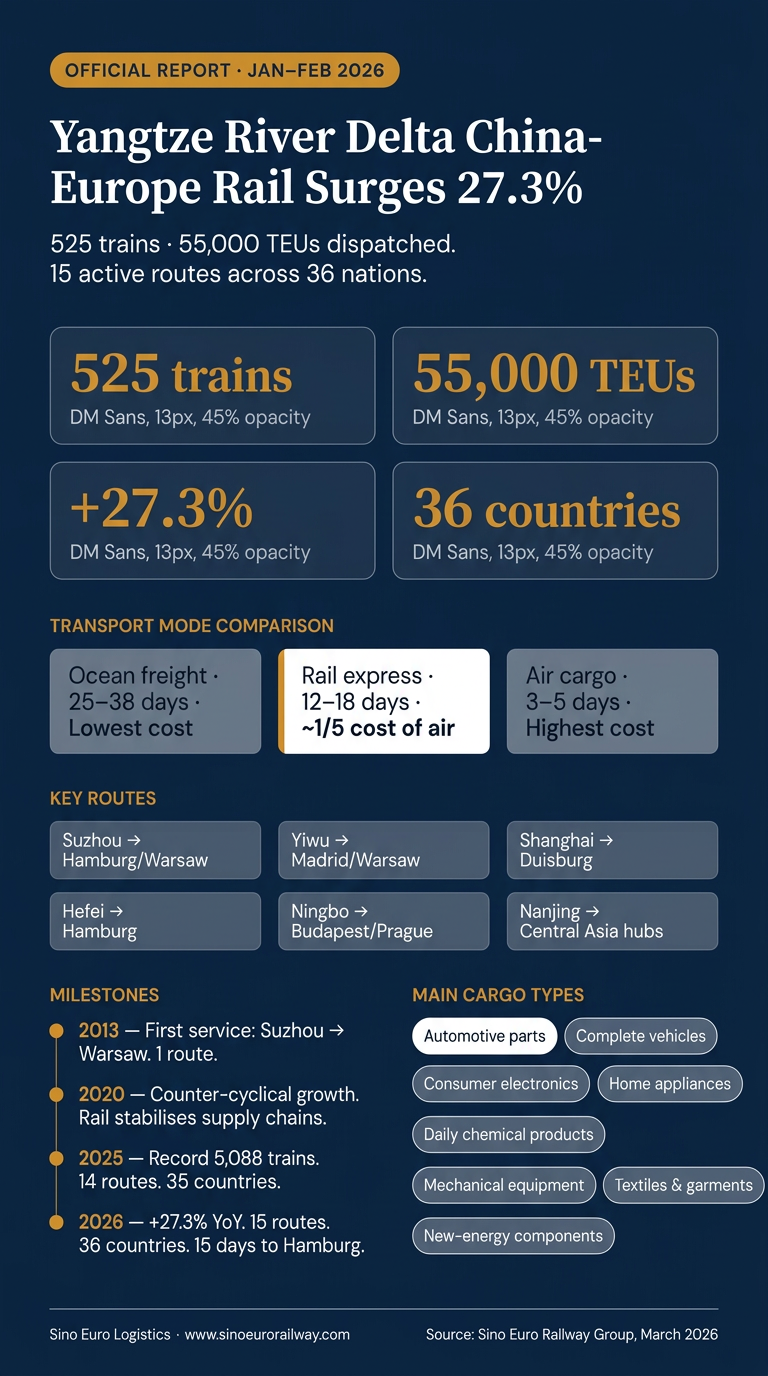
In January and February 2026, China-Europe (Central Asia) freight trains operating from the Yangtze River Delta dispatched a combined 525 trains carrying 55,000 TEUs — a year-on-year increase of 27.3% in both train count and container volume. Since the inaugural service in 2013, the network has grown from a single route to 15 operational lines now reaching 36 countries across Europe and Asia. The Yangtze River Delta has firmly established itself as one of China’s most strategic China-Europe rail hubs.
1. The Numbers: A Commanding Start to 2026
According to official data released by Sino Euro Railway Group Co., Ltd. on 5 March 2026:
| Indicator | Figure | Period |
|---|---|---|
| Trains dispatched | 525 | Jan–Feb 2026 |
| TEUs shipped | 55,000 | Jan–Feb 2026 |
| Year-on-year growth | +27.3% | vs. Jan–Feb 2025 |
| Active routes | 15 | As of March 2026 |
| Countries served | 36 (25 in Europe, 11 in Asia) | As of March 2026 |
| Cumulative trains since 2013 | 32,000+ | Through end of 2025 |
| Europe-bound (cumulative) | ~16,000 trains | Through end of 2025 |
| Asia-bound (cumulative) | ~16,000 trains | Through end of 2025 |
| Full-year 2025 total | 5,088 trains / 516,000 TEUs | +7.3% YoY in TEUs |
Primary cargo types: complete passenger vehicles, automotive components, daily chemical products, consumer electronics, mechanical equipment, textiles, furniture, and new-energy products.
2. From One Route to Fifteen: Twelve Years of Sustained Growth
The first China-Europe (Central Asia) freight train from the Yangtze River Delta — the Suzhou–Warsaw service — was launched on 29 September 2013. What began as a single experimental corridor has since become the backbone of China’s overland trade with Europe and Central Asia.
Key milestones:
| Year | Milestone |
|---|---|
| 2013 | Inaugural service launched (Suzhou → Warsaw); 1 operational route |
| 2020 | Counter-cyclical growth during global pandemic, stabilising supply chains |
| 2024 | 4,647 trains dispatched; 480,000 TEUs shipped; +10.4% YoY |
| 2025 | Record-breaking 5,088 trains; 516,000 TEUs; network expanded to 14 routes |
| Jan–Feb 2026 | 525 trains; 55,000 TEUs; +27.3% YoY; routes expanded to 15 |
Europe destinations (selected): Duisburg (Germany), Hamburg (Germany), Warsaw and Małaszewicze (Poland), Budapest (Hungary), Prague (Czech Republic), Madrid (Spain), Helsinki (Finland), Riga (Latvia)
Central Asia & beyond: Astana and Almaty (Kazakhstan), Tashkent (Uzbekistan), Ashgabat (Turkmenistan), Baku (Azerbaijan), Tbilisi (Georgia), Tehran (Iran)
3. Why Is the Yangtze River Delta Rail Network Growing So Fast?
Manufacturing gravity and cargo match
The Yangtze River Delta — encompassing Shanghai, Jiangsu, Zhejiang and Anhui — accounts for roughly one quarter of China’s GDP and is the country’s densest concentration of export-oriented manufacturing. Yiwu primarily ships small commodities to European countries; Suzhou mainly transports electronic products and electrical appliances to Hamburg and Warsaw; while Hefei focuses on shipping white goods and mechanical products to Hamburg. This city-level specialisation creates a highly efficient cargo aggregation model that few other rail corridors can replicate.
A compelling cost-time matrix
By the end of 2025, the fastest China-Europe (Central Asia) freight train services from the Yangtze River Delta could reach Astana, Kazakhstan, in nine days and Hamburg, Germany, in 15 days. The transport time is about one-third of that by sea, and the cost is approximately one-fifth of that ,This positions China-Europe rail squarely between ocean freight (cost-efficient but slow) and air cargo (fast but expensive) — an increasingly attractive option as exporters face mounting pressure on both delivery timelines and logistics budgets.
Cargo diversification beyond traditional goods
In addition to traditional small commodities and electronic products, the share of textiles, automobiles and parts, mechanical equipment, and furniture has been growing steadily. Higher-value cargo generates stronger yield per train and supports the economic case for route expansion.
The return-journey advantage
A dimension often overlooked in Western trade coverage is the growing importance of inbound services. Return China-Europe (Central Asia) freight trains are reshaping the transportation landscape of imported raw materials. Cotton yarn imported from Uzbekistan is transported via these trains to multiple locations in Jiangsu, Zhejiang and Fujian, where it is promptly scheduled for production in local renowned textile enterprises. Electrolytic copper from Uzbekistan and Kazakhstan is delivered by return trains to the electronics component manufacturing sector in Shanghai and Zhejiang. Pulp imported from Russia is consistently supplied to papermaking enterprises in Henan and Anhui.This two-way balance strengthens route viability, reduces empty-running costs, and creates a compounding network effect as more importers and exporters anchor their logistics around the same rail corridors.
Policy alignment in a “stabilise foreign trade” year
China’s 2026 government work agenda explicitly prioritises foreign trade stabilisation. Railway freight has received expanded operational and financial support, accelerating capacity deployment precisely when demand is surging.
4. What This Means for European Importers and Chinese Exporters
For European buyers sourcing from China
The expansion to 15 routes and 36 countries means more origin cities, more scheduling options, and greater network redundancy. European importers — particularly those in Germany, Poland, Hungary and Spain — now have access to faster, more reliable overland supply chains that are substantially less exposed to ocean-freight disruption events such as Suez Canal congestion or port strikes.
For Chinese exporters shipping to Europe
Demand is outpacing available capacity on the most popular corridors. The 27.3% year-on-year growth recorded in January and February is a leading indicator of a tighter market through the spring peak season. Exporters who have not yet locked in freight capacity should act quickly.
Three practical steps for the 2026 spring shipping cycle
Book early. A 27.3% demand surge compresses available slots rapidly. Aim to confirm bookings 7 to 10 working days ahead of your intended departure, particularly on high-demand routes such as Suzhou–Hamburg and Yiwu–Warsaw.
Use route diversity to your advantage. With 15 active routes, there is rarely a single optimal answer. Work with a specialist freight forwarder to evaluate transit time, port of entry, local delivery cost and customs clearance efficiency for your specific destination.
Consider a full-year rate agreement. Given that freight rates have risen in line with demand during the spring 2026 peak, shippers with predictable export volumes are well served by negotiating a longer-term pricing framework to smooth out seasonal volatility.
5. Frequently Asked Questions
What departure cities are available for China-Europe rail services from the Yangtze River Delta?
The primary consolidation hubs are Shanghai, Suzhou, Hangzhou, Ningbo, Hefei, Nanjing, Yiwu, Wuhu, Jinhua, Xuzhou, and Lianyungang. Cargo is aggregated at these points via road or sea-rail intermodal connections before departing on scheduled block train services. Each city has a distinct cargo specialisation, which allows shippers to optimise their pick-up and loading arrangements.
Which European cities can China-Europe rail freight reach from the Yangtze River Delta?
As of March 2026, the network serves 25 European countries. Core hub destinations include Duisburg and Hamburg in Germany, Warsaw and Małaszewicze in Poland, Budapest in Hungary, Prague in the Czech Republic, and Madrid in Spain. These hubs connect to last-mile road distribution networks serving most of continental Europe.
What is the transit time from China to Europe by rail?
Transit times range from approximately 12 to 18 days depending on the origin city, destination, and border crossing conditions. The fastest confirmed service as of end-2025 covers the Yangtze River Delta to Hamburg in 15 days. This compares favourably to sea freight transit times of 25 to 38 days on the same corridor.
What types of goods are best suited to China-Europe rail freight?
Rail freight is well suited to high-value, time-sensitive cargo that cannot justify air freight costs. Typical categories include: automotive components and complete vehicles; consumer electronics and home appliances; daily chemical and personal care products; mechanical equipment and industrial machinery; textiles and garments; furniture; and new-energy components including solar panels and battery modules. Hazardous materials are subject to additional restrictions and require specialist handling.
Have China-Europe rail freight rates changed in 2026?
Rates on the highest-demand routes have increased modestly in line with the spring 2026 capacity squeeze. Shippers with regular volumes are advised to engage their freight forwarder early and explore annual volume-based agreements to lock in competitive pricing ahead of further tightening.
How does China-Europe rail compare to ocean freight and air cargo?
Rail occupies a strategically valuable middle ground. Compared to ocean freight, it offers transit times roughly two thirds shorter, making it the preferred mode when delivery schedule matters but air freight is not commercially viable. Compared to air cargo, it costs approximately one fifth as much for equivalent shipments, making it far more accessible for bulkier or lower-margin goods. For many Yangtze River Delta exporters, particularly those shipping to Central and Eastern Europe, rail is now the default choice rather than a premium alternative.
- +8613510097264
- +8675583171661
- Contact us by Skype
Joe
 QQ Service
- +8613510097264