
If you’ve been following the “Steel Silk Road” for a while, you know the drill. We talk about potential, we talk about “alternatives,” and we talk about a future that always feels just around the corner.
But as of January 2026, that corner has been turned.
We aren’t just looking at projections anymore; we are looking at a system that has found its rhythm. The headlines from the first two weeks of this year aren’t about “trying” new things—they are about the massive, coordinated scale of what is already working.
The 11-Day Milestone is No Longer a “Record”
For years, getting a train from Xi’an to Budapest in under 12 days was a front-page achievement. Today, it’s becoming the baseline.
On January 1, 2026, the first Trans-Caspian (TITR) service of the year pulled out of Xi’an. What used to be a 20-day odyssey across the sea and land has been compressed into just 11 days. This isn’t just about speed for speed’s sake; it’s about the “cash flow win.” When a shipment of photovoltaic modules—like the 45 containers that kicked off our year—reaches its destination in 11 days instead of 45, that’s over a month of capital that isn’t trapped in a floating metal box.
New Routes for a New Economy
We’re seeing the map expand in ways that actually make sense for modern manufacturing. Take the new Wuhan-to-Copenhagen direct link that launched on New Year’s Day. It’s the first time Hubei has had a straight shot to a Nordic capital.
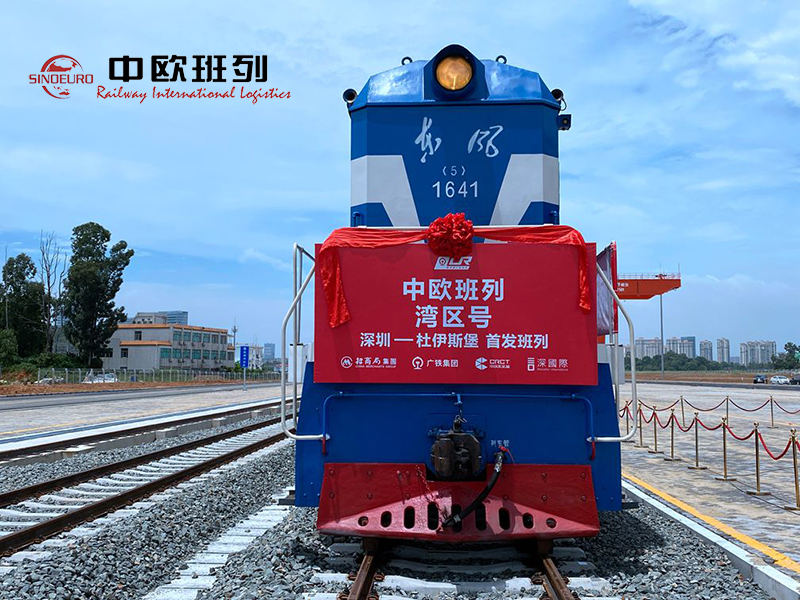
Then there’s the Guangdong-Hong Kong-Macao Greater Bay Area (GBA). Just this week, a train left Zengcheng West Station bound for Malaszewicze, Poland, loaded with $2.8 million worth of high-end electronics and consumer goods.
The cargo mix has shifted. We aren’t just moving raw timber and base metals. We are moving high-value LCD monitors, refrigerators, and New Energy Vehicles (NEVs). The rail has evolved from an emergency workaround into the strategic artery of the global tech industry.
The Tech Behind the Transit
Why is this happening now? Because the “friction” at the borders is finally being sanded down.
At Alashankou, the legendary bottleneck of the northwest, they just cleared a record 8,165 trains in 2025. By implementing AI-driven imaging and “Smart Eye” inspection portals, customs clearance times have been slashed by nearly 20%. On average, a returning train can now swap its gauge and reload in about two hours.
It’s quiet, it’s digital, and it’s fast.
Looking Ahead: The Chinese New Year Prep
With Chinese New Year arriving on February 17, 2026, the “January Rush” is in full swing. We’re seeing a flurry of activity as exporters try to beat the factory shutdowns.
If you’re planning your Q1 logistics, the “Full-Timetable” services are your best friend right now. They offer the one thing that sea freight often lacks during the holiday scramble: predictability.
The Bottom Line: The 120,000 journeys completed by the end of last year weren’t just a milestone—they were a proof of concept. Whether you’re moving solar panels via the Trans-Caspian corridor or electronics into the heart of Poland, the “Steel Silk Road” is finally operating at the speed of your business.
What’s your next move?
The 2026 rail schedule is more dense and diverse than ever. If you’re wondering how the new Wuhan-Nordic or GBA-Poland routes fit into your specific supply chain, let’s talk. We can run a quick comparison of your current lanes against the latest January performance data.
- +8613510097264
- +8675583171661
- Contact us by Skype
Joe
 QQ Service
- +8613510097264
- English
- French
- German
- Portuguese
- Spanish
- Russian
- Japanese
- Korean
- Arabic
- Irish
- Greek
- Turkish
- Italian
- Danish
- Romanian
- Indonesian
- Czech
- Afrikaans
- Swedish
- Polish
- Basque
- Catalan
- Esperanto
- Hindi
- Lao
- Albanian
- Amharic
- Armenian
- Azerbaijani
- Belarusian
- Bengali
- Bosnian
- Bulgarian
- Cebuano
- Chichewa
- Corsican
- Croatian
- Dutch
- Estonian
- Filipino
- Finnish
- Frisian
- Galician
- Georgian
- Gujarati
- Haitian
- Hausa
- Hawaiian
- Hebrew
- Hmong
- Hungarian
- Icelandic
- Igbo
- Javanese
- Kannada
- Kazakh
- Khmer
- Kurdish
- Kyrgyz
- Latin
- Latvian
- Lithuanian
- Luxembou..
- Macedonian
- Malagasy
- Malay
- Malayalam
- Maltese
- Maori
- Marathi
- Mongolian
- Burmese
- Nepali
- Norwegian
- Pashto
- Persian
- Punjabi
- Serbian
- Sesotho
- Sinhala
- Slovak
- Slovenian
- Somali
- Samoan
- Scots Gaelic
- Shona
- Sindhi
- Sundanese
- Swahili
- Tajik
- Tamil
- Telugu
- Thai
- Ukrainian
- Urdu
- Uzbek
- Vietnamese
- Welsh
- Xhosa
- Yiddish
- Yoruba
- Zulu