China–Europe freight trains pass 140,000 trips: What does the milestone mean for a shipment?
Published October 28, 2026 · Sino-Euro Railway
On 22 October 2026, China–Europe freight trains passed 140,000 cumulative trips. This is an industry-wide network milestone since operations began in 2011, not the number of trains or available slots in a particular week, and not the achievement of any one logistics company. For a shipper, it describes long-term network development; it does not replace checks on the cargo, departure and delivery location for an individual shipment.

What does the 140,000 figure measure?
Xinhua reported on 22 October that a Moscow-bound China–Europe freight train left Puhe station in Shenyang, Liaoning, marking more than 140,000 cumulative trips. The report also cited China State Railway Group on the network's reach across European and Asian cities. China Daily's report of 23 October makes clear that the cumulative count runs from the network's start in 2011.
“China–Europe freight trains” is the name of the network and service in the reports; it does not mean that every shipment is destined for the European Union. Moscow, the destination of the milestone train, is outside the EU. The cumulative number of train trips is not a count of shipments or containers, nor current capacity on a particular route. It cannot show whether space is available in a given departure week.
What needs checking for an individual order?
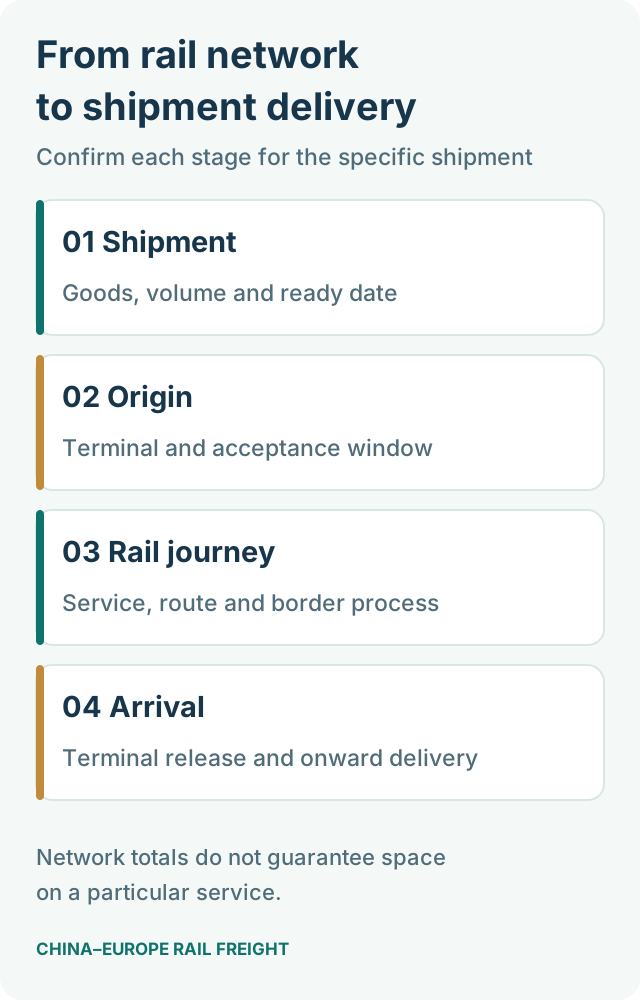
Network coverage provides context for transport choices. For a particular order, the collection point, final delivery address, cargo-ready date and latest acceptable delivery date determine which collection and delivery stages need assessment. A city appearing in a network report does not mean that a particular train delivers directly to the customer's warehouse.
First check whether the proposed service accepts the cargo, whether space can be booked, and whether cargo cut-off, container loading and documentation can be coordinated. Product description, packaging, weight, volume and cargo characteristics affect acceptance; confirm the container type and source, and whether a full-container or shared-container option is actually available. Acceptance depends on the specific product and carrier arrangements.
Arrival at the destination rail terminal is not the same as delivery to the consignee. Terminal handling, applicable customs procedures, collection and final delivery, as well as the consignee's receiving window, can all affect the outcome. Clarify who arranges each stage, which charges are included and which documents are needed before discussing the estimated end-to-end time; a rail line-haul time alone is not a door-to-door commitment.
Does a larger network make delivery easier?
A wider network may give shippers more options to evaluate, but the benefit for an individual order depends on bookable services, cargo acceptance and connections at both ends. If onward delivery from the destination terminal is unconfirmed, or the cargo-ready date does not match the cut-off, the network's size alone cannot resolve the issue.
Compare proposals using the same origin and destination, service scope, cargo details and dates. Check the quotation's validity and each included or excluded charge. Do not assume space, a fixed transit time or a direct end-to-end service for stages that have not been confirmed.
Frequently asked questions
Do more than 140,000 cumulative trips mean space is available to every European destination now?
No. The figure is the industry-wide cumulative count from 2011 to 22 October 2026; it does not show bookable capacity for a particular week, terminal or product. Confirm availability for the cargo-ready date and destination.
Does the cumulative count cover only transport between China and the EU?
No. The milestone train in the reports was bound for Moscow, outside the EU, and the network described also reaches other cities in Europe and Asia. The network's name is not an EU-only freight statistic.
Has the cargo been delivered to the consignee when the train reaches its destination terminal?
Not necessarily. Terminal handling, applicable customs procedures, collection and final delivery may still be outstanding. Confirm responsibilities, charges and the receiving window before booking.
To assess a China–Europe rail shipment, share the origin, delivery address or postcode, product and cargo characteristics, packaging, weight and volume, cargo-ready date and latest delivery date. We can help check feasible options, service scope and shipment-specific quotation terms.
Useful next steps
Explore FCL and LCL rail services, European terminal guides and what a COC or SOC quotation includes. Request a shipment-specific quotation.
Need rail freight from China to Europe?
Share your route, cargo and ready date. We will confirm the rate, included charges, validity and transit estimate for your shipment.