European rail interoperability: why a route map cannot prove faster China–Europe delivery
Published October 2, 2026 · Sino-Euro Railway
A connected railway map does not establish a continuous, bookable freight service. Signalling, operating resources and terminal handovers also have to fit. New European interoperability research is relevant to long-term planning, but does not mean China–Europe rail freight has already become faster.

Information checked: 2 October 2026 | Industry analysis | Sino-Euro Railway
What the new study concerns
On 1 October 2026, the European Commission published news of a study on ERTMS trackside deployment. It identifies fragmentation, national requirements and integration with older systems as sources of cost and complexity, recommending closer alignment and better deployment processes. European Commission announcement, 1 October 2026
ERTMS is a signalling and train-control framework supporting railway interoperability. It is technical infrastructure, not a newly opened freight route. The announcement does not provide a transit-time reduction for a China–Europe freight product or confirm additional bookable capacity.
Three separate layers to check
| Layer | What needs to work | What it does not establish |
|---|---|---|
| Technical systems | Compatible signalling and train control, coordinated deployment | Track gauges have not thereby become identical. |
| Operations | Available train arrangements, suitable resources and connected handovers | A line on a map does not mean this cargo can travel on a particular date. |
| Cargo delivery | Customs, terminal handling, collection and onward delivery | Technical alignment does not remove clearance or final-mile waiting. |
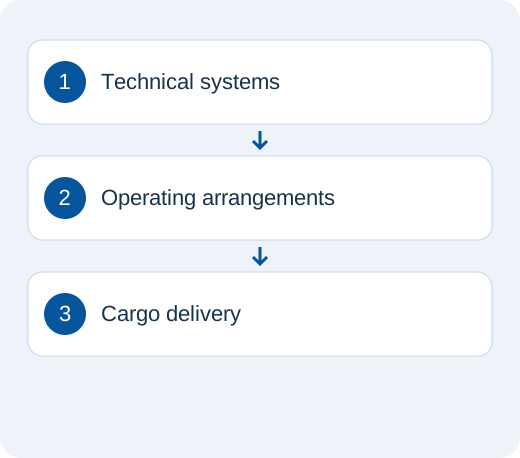
Calling all three layers a single standardisation problem hides tasks that still need owners and confirmation. A policy direction cannot replace a shipment-specific acceptance or delivery plan.
What it means for near-term orders
Our assessment is that more coordinated technical deployment can improve long-term conditions for European cross-border rail. Turning that potential into better delivery requires implementation, operating changes and evidence from actual performance.
For the 3 October–2 November 2026 planning window, look for confirmed changes on the selected route: departures, acceptance arrangements, transloading and handover times, and compatibility with warehouse receiving requirements. These are decision inputs, not a forecast that the study will improve service during that month. If no relevant operating change is confirmed, do not reduce delivery buffers on the strength of the announcement.
Longer-term route reviews should consider handover and final-mile reliability as well as distance. Technical compatibility is a useful variable, but not a reason by itself to postpone a current booking.
How to verify a faster-transit claim
First align the scope. Terminal-to-terminal, border-to-terminal and collection-to-receipt describe different journeys. Then establish the exact start and end points, cargo conditions and applicable dates; a city name may cover several operating nodes.
Ask whether the figure is a plan, a commitment under stated conditions or historical performance with a defined sample and observation period. A faster-service claim should identify which leg changed and whether the change applies to this shipment. Ask: how does it affect my route, when does it apply, and which delivery milestone changes? Without those answers, do not revise the contractual receipt date.
Does ERTMS remove gauge-change handling?
No. Signalling and train control are different from track gauge. Coordinating one does not remove differences in the other.
Does the study create a uniform China–Europe transit time?
No. Research recommendations are not changes to a particular freight service. Timing still depends on endpoints, available arrangements, customs and final handovers.
Should I wait for technical improvements before shipping?
Not solely because of this news. Plan current orders using confirmed resources and track implementation and operating evidence for future decisions.
For a shipment assessment, provide origin, receiving address, cargo details and latest acceptable receipt date. Read also the European distribution-node checklist.
Need rail freight from China to Europe?
Get a transparent quote in seconds, or talk to our team about your shipment.